Republic Of Palestine - February 2026
Watan Jamil Alabed
Palestinian Writer
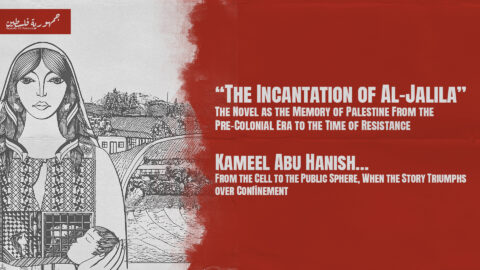
Kameel Abu Hanish… From the Cell to the Public Sphere, When the Story Triumphs over Confinement
It is impossible to approach The Incantation of Al-Jalila without situating it within the personal and political experience of its author, Kameel Abu Hanish, whose biography constitutes one of the essential keys to understanding his literary project. Abu Hanish, a liberated Palestinian prisoner, spent more than two decades in Israeli occupation prisons, where the cell was not a space of isolation so much as it became a laboratory of consciousness and writing—a site for rethinking freedom, memory, and identity.
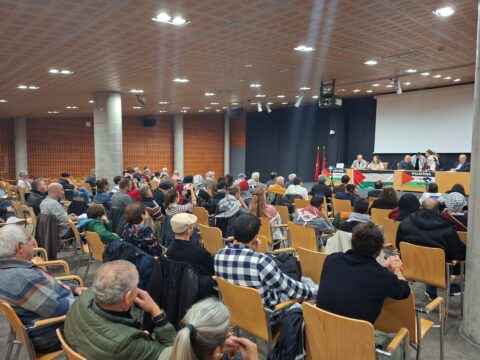
After nearly a quarter century of imprisonment, Palestinians witnessed a moment of profound symbolic significance: Kameel Abu Hanish publicly signing a novel he had completed inside Ramon Prison. This was not a passing cultural detail, but a declaration of the triumph of storytelling over captivity, and the emergence of the text from darkness into light, as an act of resistance no less meaningful than any other form of confrontation.
In an interview published on the website Republic of Palestine – Episodes of Freedom, Abu Hanish articulates a deep understanding of writing as a liberatory practice inseparable from struggle, one that reshapes resistance at the level of consciousness and meaning. In his experience, prison was not merely a physical punishment, but a systematic attempt to break memory—an attempt he confronted by transforming writing into a tool for preserving the Palestinian collective self, and into a form of long-term, patient resistance.
From this perspective, The Incantation of Al-Jalila does not appear as an isolated literary work, but as a natural extension of an intellectual and literary project that views narrative as a means of reclaiming stolen Palestinian time and writing history from within— from the standpoint of lived experience, not from the margins of official accounts. It is a novel that does not simply retrieve what was, but interrogates what happened, and dismantles the ways in which memory itself became a central arena of struggle.
Palestine’s Geography Pre-Zionist Colonization: Geography as an Identity
The novel begins in a living Palestine prior to Zionist colonization, where land is not property but a living entity, and villages are not points on a map but fully formed communities. Geography here is not a backdrop but a historical actor: fields, citrus groves, roads, seasons, rain, and agricultural labor all shape the Palestinian’s awareness of self and place.
This deliberate portrayal reaffirms a fundamental truth: Palestine was not a land without a people, but a homeland with an integrated social fabric that would later be targeted for uprooting.
The British Mandate: The Beginning of Structural Rupture
With the advent of British rule, the novel traces a profound structural transformation: the shift of power, the alteration of laws, and the infiltration of the Zionist project under colonial protection. The Mandate is not presented as an abstract political event, but as a force that began dismantling the organic relationship between people and land, planting fear, suspicion, and instability within a society that had long been anchored in its historical rhythm.
The Village of Al-Khayriyya: The Larger Community before the Break
The village of Al-Khayriyya appears as the broader social structure encompassing families and housh. It is a social, economic, and cultural unit governed by custom, solidarity, and horizontal relationships. In Al-Khayriyya, rural Palestine before the Nakba comes into view: cooperation, markets, celebrations, seasons, and a life organized around a solid social order.
Housh* Yousef: Structural Division and Familial Cohesion
Within this larger community, Housh Yusuf occupies the position of the beating heart. The housh is not merely an architectural space, but a social structure that is simultaneously closed and open: private to the family, yet open to the collective. Its internal divisions—rooms, courtyard, levels—reflect intense familial cohesion, where the individual belongs to the whole, and the whole safeguards the individual.
The novel presents the housh as a model of cohesion that would later become a direct target of colonial assault.
Al-Jalila and the Young Man: Love in a Time of Stability
The story of Al-Jalila and the young man (Mustafa) is not written as an isolated romance, but as part of a normal life before catastrophe. Love here extends from the land to the family and to a possible future. This human dimension lends the novel a particular depth, for what will later be lost is not only land, but an entire life that could have been.
Grandmother Arifa: Folk Wisdom and the Incantation
Grandmother Arifa embodies popular memory, inherited wisdom, and the link between the unseen and meaning. The incantation that gives the novel its title is not superstition, but a psychological and spiritual survival mechanism to which the community turns when politics and weapons can no longer explain devastation.
Al-Qassam, the Strike, and the Revolution: The Popular Cradle
The novel documents the martyrdom of Sheikh Izz al-Din al-Qassam, the Great Strike, and the Palestinian Revolution not as cold historical facts, but as lived events embraced by the people. The popular base emerges as the decisive element: resistance was not the act of an elite, but a broad societal condition.
The Martyrdom of Amin and Sa‘id and the Women’s Ululations*
In a scene heavy with meaning, the novel pairs martyrdom with women’s ululations, not as a denial of grief, but as a transformation of loss into stance. The zaghrouta becomes a political act—an announcement that blood will not be the end of meaning.
The Nakba: When Time Broke, but the People Did Not
The Incantation of Al-Jalila does not treat the Nakba as a fleeting event, but as a succession of heavy, slow, accumulating days, where destruction does not arrive all at once, but seeps in. The Nakba begins with fear, rumor, distant gunfire, and then crystallizes into an unavoidable reality: forced departure, houses abandoned in haste, keys hidden in pockets, and mothers recounting their children every few steps.
In one of the novel’s most devastating passages, departure is described not as a decision, but as an uprooting:
“We did not leave the houses; the houses suddenly expelled us, as though the land itself had panicked.”
Here, the Nakba is not only the loss of place, but the collapse of time itself. What was planned for tomorrow is abruptly cancelled; what was temporary becomes permanent. Then come the camps: tents, queues, flour, waiting. Refugees are transformed from owners of land into bearers of memory, waiting for a return that will stretch on.
Land and Construction: Transforming Defeat into Survival
After the shock, the novel does not abandon its characters to existential exposure. Al-Jalila leads us to a central idea: defeat is not measured by what is lost, but by what is built afterward. In camps, in exile, and in temporary shelters, a parallel process of construction begins—the construction of the human being and of meaning.
Al-Jalila says in a passage that encapsulates her philosophy:
“Land is not only what we are expelled from; land is what we carry in our minds and plant wherever we are forced to live.”
Thus, building was not a denial of the Nakba, but a response to it. A stone house, a school, a tree, a child named after a destroyed village—each becomes a form of silent resistance, insisting that the Palestinian does not live provisionally, not even in exile.
Gamal Abdel Nasser: Arab’s Hope
Gamal Abdel Nasser rekindles a collective hope that transcends borders, appearing as a symbol of a period in which Palestinians believed the Arab nation might reclaim its role.
Salim and Al-Nouriya*: The Clash of Social Norms
Through Salim and Al-Nouriya, the novel explores conflicts of custom, revealing society not as a monolithic block, but as a permanent arena of tension between tradition and change.
Wars and Defeats: A History Written in Disillusionment
The novel chronicles successive stages of Arab wars and defeats, not merely as military confrontations, but as a chain of disillusionments that shaped collective consciousness. Hope renews itself, only to collapse again, returning everyone to zero.
Yet the text does not sink into self-reproach; instead, it shows how every defeat generated a new form of awareness. When armies fell, the idea did not. When regimes were exposed, Palestinians increasingly relied on themselves.
The Return to Salama: Confronting Dani
The return of Awda and Mustafa to the village of Salama, and their encounter with Dani, who seized their home, stages a confrontation between two narratives: historical right versus force-protected usurpation.
Fedayeen* Action and Awda
Awda joins the fedayeen struggle, then disappears, turning absence itself into a form of presence.
The Inheritance of the Rifle: From Memory to Action
In The Incantation of Al-Jalila, the rifle does not appear suddenly, but emerges as the natural outcome of a long history of injustice. It is inherited as stories are inherited, from generation to generation—not merely as a tool, but as an ethical responsibility.
Al-Jalila warns against the rifle when it becomes detached from meaning:
“A rifle that does not know why it is carried may fire at its own bearer.”
Here, the novel draws a clear distinction between resistance as a conscious act and violence as blind reaction. It unmistakably aligns itself with the former.
Revolutionary Action: When Action Becomes a Necessity
As the political horizon closes, revolutionary action advances in the novel as a historical choice rather than a romantic one. We witness organization, secrecy, pursuit, fear, and weighty decisions that are never taken lightly. Armed struggle is not portrayed as individual heroism, but as collective action surrounded by anticipated loss.
Arrest, Intifada, and Popular Resistance
Al-Jalila is arrested, the First Intifada erupts, and scenes of popular resistance and the arrest of collaborators unfold.
Fadi: Captivity and Steadfastness
Fadi is captured, withstands interrogation, and emerges from prison, ushering in the Oslo period with all its contradictions.
Awda’s Return after Twenty-Six Years
Awda returns after twenty-six years, affirming that absence does not erase belonging.
Memory, the Telephone, and the Diaspora
The telephone that connects Al-Jalila’s siblings across the diaspora becomes a symbol of the unity of memory despite dispersion.
The Martyrdom of Hassan: Blood That Opens the Path
Hassan’s martyrdom constitutes one of the novel’s pivotal moments—not because it is the first, but because it occurs at a moment of historical awareness, when all understand that the road will not be short, and that what the story has begun cannot end with one individual. His death is not written in epic tones, but through heavy sorrow, prolonged silence, and then continuation, as though loss itself becomes part of action.
One character says:
“Hassan died, but the road did not die with him.”
In this context, the novel quietly delivers its resonant statement:
“Every stage has its men…”
Not as consolation, but as an understanding of historical process: when a stage hardens, it does not select its men from outside—it matures them within its core. Here, the novel reasserts that martyrdom is not the end of the narrative, but its beginning, and that blood, when shed with awareness, does not close the path but opens it to a new generation.
The Death of Al-Jalila: The Final Ululation and the Meaning of Completion
The text devotes extensive space to Al-Jalila’s death, as though the entire novel had been preparing for this moment. She does not depart in silence, but as she lived—gathering people around her. The final ululation is not a rupture of custom, but the culmination of a long journey of transforming loss into strength.
In the closing scene, Nasra exclaims:
“I swear to God, lest blemish, I would have let out a thunderous ululation of joy at this majestic sight. Who would have believed that this woman who left Salama with only her clothes and children would leave behind all these men, youths, and young women…?”
Ululations erupt—not in mockery of death, but in triumph for the life Al-Jalila planted in everyone. The old pendant around her neck—carried since childhood—glimmers one last time, as though encapsulating the entire novel: what is inherited does not die.
The Lesson: What Al-Jalila Represents for the Palestinian People
Al-Jalila is not merely a fictional character, but an embodiment of popular, resistant Palestine:
• A woman who did not carry the rifle, but carried meaning
• She left Salama with her clothes and left behind generations of resisters
• She lived through the Nakba, wars, and betrayals without losing her compass
In every generation, as the novel implicitly suggests, there was:
a martyr, a fugitive, a prisoner… and a woman who preserved the story.
Thus, The Incantation of Al-Jalila ends not with loss, but with certainty:
All of it is our land,
all of it our soil.
As long as memory remains alive,
and the story continues to be told,
defeat will not be destiny.
Notes:
- Housh Yousef: refers to a traditional Palestinian courtyard, typically part of an extended family compound, where multiple generations once lived around a shared open space. More than an architectural form, the housh functioned as a social, cultural, and emotional nucleus—a place of daily life, storytelling, collective memory, and communal resilience.
- In the Palestinian context, Housh Yousef carries an added symbolic weight: it evokes belonging, rootedness, and the continuity of life disrupted by displacement and occupation. It stands as a spatial memory of home, intimacy, and collective identity.
- Ululation (zaghārīd / الزغاريد): in the Palestinian experience, is the transformation of the voice into celebration, even in the midst of the wound; it is a joy that resists.
- Ululation breaks into public space as a declaration of existence, as a celebration that defies the logic of silencing. Each zaghārīd is an affirmation of life in the face of systematic attempts to erase it—an unpermitted joy and a victory spoken through the voice.
- Al-Nouriya Nā‘ūriya /نورية In Palestinian usage, Nouriya refers to a woman associated with itinerant or marginalized communities, often perceived as living outside settled village life. The term does not always indicate a precise ethnic identity (such as Roma), but rather a social image shaped by movement, otherness, and distance from dominant norms.
- Fedayeen: (singular: Fedayee (فدائيين\ فدائيPalestinian fighters engaged in armed resistance, defined by voluntary sacrifice—placing the people before the self, and freedom before life—in the pursuit of national liberation and social justice.