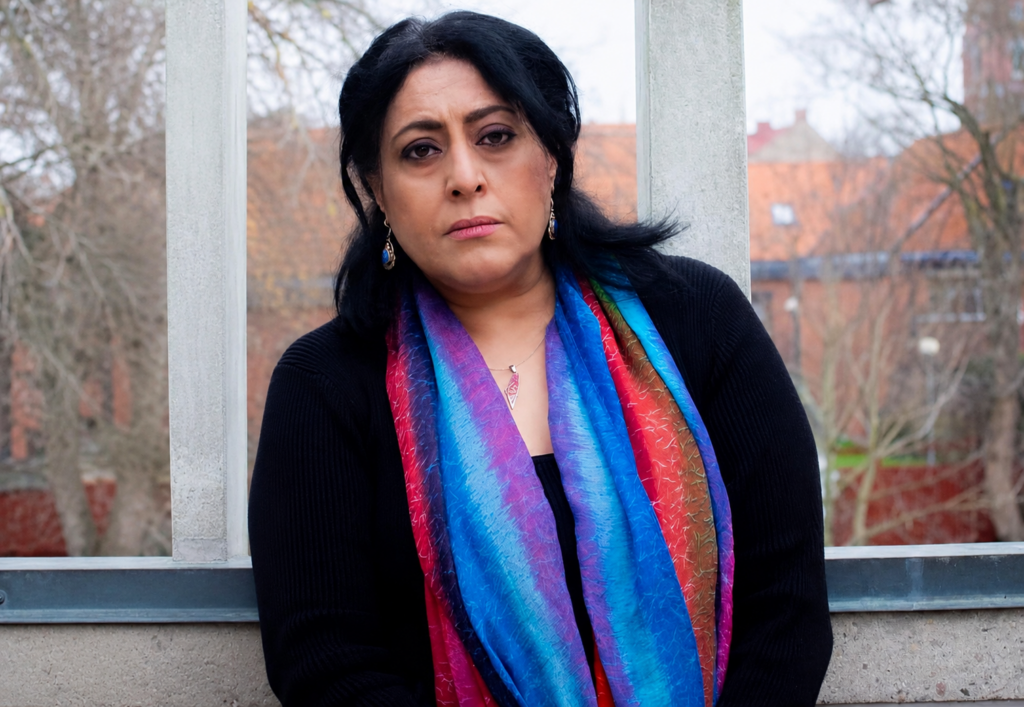

By: Bisan G. A. Edwan
“Evil does not always arise from hatred or a desire to harm, but sometimes from blind obedience to rules, and from turning professional duty into a tool for silencing the truth.” — Hannah Arendt
Sweden has long been presented as one of the most stable and progressive democracies in the world. For decades, its name has been associated with the welfare state, political neutrality, freedom of expression, strong trade unions, the defense of human rights, and international solidarity. The “Swedish model” was not merely a successful administrative system, but a complete moral image of a society that had managed to reconcile social justice with parliamentary democracy.
But this image is now facing a profound crisis. In recent years, the gap has begun to widen between the official democratic rhetoric and the political and social reality experienced by many Swedes. The crisis is no longer simply about the rise of the populist right or the shift in the European political climate; it now touches the very nature of Swedish democracy: the limits of political representation, the role of the media, the power of security institutions, the relationship between the state and capital, and the decline in society’s ability to effectively influence crucial decisions. At the heart of this crisis, Palestine has emerged as a revealing mirror.
What is happening in Gaza has not only exposed the limitations of the international order and humanitarian law, but also the limits of European democracy itself, including in Sweden. The way solidarity with Palestine is handled has become a true test of freedom of expression, the space for political dissent, and the extent to which Western democracies are willing to uphold the values they claim to defend when these values conflict with geopolitical interests and security alliances. From the welfare state to a crisis of confidence: A recent poll showed that 44% of Swedes believe Swedish democracy is headed in the wrong direction. This figure does not reflect mere passing political discontent or a temporary state of partisan division, but rather points to a deeper crisis related to declining trust in political institutions and the very idea of democratic representation. The traditional image of Sweden as a model of social stability and political consensus has gradually begun to crumble in the face of accumulating economic, social, and political transformations. The legitimacy of the modern Swedish state was built on what was known as the democratic social contract: a strong state providing education, healthcare, social security, and decent work, in exchange for broad political participation through parties, unions, and civic institutions.
This model was not merely an economic arrangement; it was the foundation of public trust, as Swedish citizens felt for decades that the state represented them and protected their fundamental interests. However, this model began to erode in the 1990s with the rise of neoliberal policies, privatization, and the decline of the state’s social role. Large sectors of public services, including education, healthcare, housing, and social services, were transferred to the market under the banner of “efficiency” and “freedom of choice.” The actual result, however, was a widening class gap, an increased concentration of wealth and economic power, and a diminished capacity of the state to play its traditional role as a guarantor of social justice.
With this transformation, the relationship between the citizen and the state began to change radically. Instead of large segments of the population feeling that political institutions represent their interests, there is a growing sense that major decisions are made within closed circles linked to economic interests, large corporations, and centers of political and media influence. Many Swedes now feel that parliamentary democracy manages crises more than it resolves them, and that elections change governments without altering the actual structure of power.
This feeling is not limited to the poor or marginalized classes; it extends to large segments of the middle class, who have begun to feel the loss of the social stability that formed the basis of the “Swedish Dream.” The rising cost of living, the housing crisis, the decline in the quality of some public services, and the rise of violence and organized crime have all contributed to deepening the feeling that the political system is no longer capable of providing the social security that was once the primary source of its legitimacy.
At the same time, trust in traditional parties, unions, and the media—institutions that historically acted as intermediaries between society and the state—has declined. For many, politics now seems detached from daily life, operating within a closed space of parliamentary agreements and technical rhetoric, while the average citizen feels that their real influence on crucial decisions is extremely limited. This crisis is not merely a crisis of confidence in institutions, but a crisis in the very meaning of democracy. When citizens feel that their vote does not change the general direction of the state, and that the available political options are largely the same regardless of who is in power, democracy begins to lose its social substance, even if its formal institutions remain intact.
****
The Illusion of Parliamentary Democracy
Modern liberal democracy rests on the fundamental premise that periodic elections and multi-party systems are sufficient to guarantee the representation of the popular will. However, political experience in many Western countries, including Sweden, reveals the limitations of this premise, especially when it comes to major structural issues affecting the economy, foreign policy, security, and profound social transformations. Despite the apparent party competition, political choices within the Swedish parliamentary system appear remarkably similar on key issues.
Whether it concerns economic policies, the relationship with the market, military spending, or security and immigration policies, the differences between the main parties are often administrative or technical rather than fundamentally different in their overall political direction.
Herein lies the central contradiction within bourgeois democracy.
Modernity: While voting is presented as the ultimate expression of the popular will, major decisions remain governed by a complex web of economic interests, security alliances, and financial and media institutions that are not effectively subject to direct democratic accountability. This is clearly evident in the climate issue.
The overwhelming majority of the Swedish people support bolder and more effective climate policies and recognize the severity of the impending environmental crisis. Yet, no parliamentary party presents a program capable of effectively addressing the climate catastrophe with the radical economic changes it requires. This is not due to a lack of knowledge or awareness, but rather to the limitations of the political system itself, which remains tied to an economic structure based on continuous growth, consumption, and the free market.
Thus, parliamentary democracy is capable of managing the debate on the crisis, but incapable of making decisions that touch the core of the economic system that produces it. The same applies to other issues, such as immigration policies, wealth distribution, or the privatization of public services.
Often, elections become a process of reproducing existing power balances rather than bringing about real change. Politicians change, but the overall direction remains the same. This has led to a growing sense among broad segments of society that politics has become detached from the genuine popular will, and that parliamentary democracy is no longer capable of representing social interests, but rather manages political stability within the limits imposed by market considerations and international alliances.
****
NATO and Sweden’s Geopolitical Transformation
Perhaps no issue has revealed the limits of contemporary Swedish democracy as clearly as Sweden’s accession to NATO. For a long time, neutrality formed a central part of modern Swedish political identity. Neutrality was not merely a military choice, but rather part of Sweden’s self-image as a state relatively independent of major geopolitical polarizations, capable of playing the role of mediator, diplomat, and defender of international law and human rights. This neutrality was also linked to the political and social memory of Saudis, as an expression of a model different from traditional imperial powers, a model that balances national security with political independence.
However, the war in Ukraine and the subsequent escalation of security rhetoric in Europe accelerated a radical shift in Swedish policy. Suddenly, joining NATO was presented as a “historical necessity” and an “inevitable choice,” even though this decision redefines Sweden’s geopolitical position for decades to come.
However, the issue is not just about joining itself, but about the way the decision was made. A decision of this magnitude, one that fundamentally affects the country’s foreign, military, and security policy, was made without a direct public referendum and without a lengthy societal debate reflecting the scale of the historical transformation underway.
For many Swedes, this revealed a genuine crisis in the concept of representative democracy: Is a parliamentary decision sufficient to change a political doctrine that has been part of the country’s identity for decades? Many felt that security anxieties and media pressure were used to narrow the space for public debate, transforming any skepticism or reservations about joining NATO into a position perceived as political naiveté or even a threat to national security.
Suddenly, Sweden found itself part of a military alliance led by the United States, a country whose name is associated with military interventions, wars, and the forceful reshaping of entire regions of the world. Here, the question began to transcend foreign policy and reach the very nature of democracy itself: Who has the right to make fateful decisions? And can we speak of a “democratic consensus” in the absence of direct popular participation in issues of this magnitude?
The NATO file also revealed the broader transformation Europe is undergoing: a shift from the logic of the welfare state and relative neutrality to that of the security state and increasing militarization. With escalating military spending and security rhetoric, political priorities began to gradually change, and the concept of “security” came to dominate public discourse at the expense of social justice and civil liberties.
In this context, the crisis of democracy in Sweden does not appear isolated from broader global transformations, but rather part of a political and economic reshaping that all of Europe is experiencing under the pressure of wars, the rise of the populist right, the increasing influence of security and military institutions, and the declining ability of societies to effectively influence fateful decisions.
Palestine as a Mirror of the Democratic Crisis (2023–2026)
Since October 7, 2023, Palestine has ceased to be merely a foreign policy issue or a geographically distant humanitarian cause for Europe in general, and for Sweden in particular. It has become a profound internal test of the very structure of democracy itself. What the war on Gaza revealed was not only the scale of colonial violence and systematic destruction, but also the limits of European liberal democracy when faced with a real test concerning freedom of expression, media independence, and the right to political dissent.
For over two and a half years, the world witnessed a genocide broadcast live from Gaza: cities destroyed, hospitals bombed, universities wiped out, journalists killed, and an entire society driven to starvation and mass displacement. Yet, despite reports from the United Nations, the International Criminal Court, and human rights organizations, European political and media discourse remained governed more by security and geopolitical considerations than by ethical or legal debate.
In Sweden, the division over the war extended beyond the political sphere to the public sphere itself. Since late 2023, profound shifts have become evident in how voices expressing solidarity with the Palestinians are treated. The debate is no longer solely about one’s stance on Israel or the war, but also about the legitimacy of solidarity itself and the limits of what can be said in the public sphere.
Palestinian, Arab, and Swedish academics, journalists, writers, and activists have become targets of smear campaigns.
This has been repeated, both in traditional media and across digital platforms. Defending international law and rejecting the killing of civilians has become a position where one must “clear oneself” politically and morally before being heard. Often, the objective is not to respond to arguments or engage in legal debate, but rather to question intentions, affiliations, and moral loyalty.
Since 2024 in particular, a new political and media discourse has emerged, linking solidarity with Palestine to “extremism,” or deeming any discourse addressing settler colonialism or the Palestinians’ right to resist as suspicious and subject to monitoring. The problem here is no longer political disagreement itself, but rather the redefinition of the boundaries of what is acceptable within Swedish democracy. Palestine has become a mirror reflecting the deep tensions within Swedish society: the tension between freedom of expression and security, between international solidarity and geopolitical alliances, and between traditional human rights discourse and the rise of the security state.
In Swedish universities, historically spaces for free debate and political critique, increasing pressure has begun to be exerted on events, seminars, and activities related to Palestine. Some institutions preferred to avoid the “sensitive subject,” while others treated solidarity with Gaza as a threat to “institutional neutrality.”
Thus, the academic sphere itself gradually began to succumb to the logic of indirect censorship and the fear of accusation. This period also witnessed a marked rise in self-censorship within the cultural and media milieu. Many journalists, writers, and researchers became more cautious in using terms like “colonialism,” “apartheid,” or “genocide,” not necessarily out of conviction, but because of the political and media climate that now associated such language with professional and social risk.
Herein lies the real danger: democracy is not measured solely by the existence of elections or a parliament, but by a society’s capacity to tolerate dissent and engage in free debate without fear. When expressing a political or legal opinion becomes fraught with moral and professional repercussions, the democratic space begins to shrink, even if its formal institutions remain intact.
Since 2025, it has become clear that the issue is no longer solely related to war, but to a broader transformation in the very structure of European democracies themselves. With the rise of security discourse in Europe and the increasing focus on “stability” and “countering extremism,” governments and media outlets have begun to redraw the boundaries of public debate in a way that makes some opinions acceptable while others are deemed morally or security-wise unacceptable.
In this context, Palestine has become a revealing issue, not because it is the only one, but because it exposes the limits of European liberal democracy when its stated values clash with political interests and international alliances.
****
Swedish Media: The Erosion of Democracy and the Manufacture of Fear
One of the most dangerous transformations Sweden witnessed between 2023 and 2026 was the gradual shift in the role of the media within democratic life. Historically, the Swedish press was associated with the image of an independent media capable of holding power accountable and opening the space for free public debate.
However, in recent years, and especially with the war on Gaza, an increasing segment of the media has begun to play a different role: not monitoring power, but contributing to the reproduction of the security discourse and defining the boundaries of what is politically and morally acceptable. In much of the coverage related to Palestine, the focus has shifted away from international law and civilian rights and towards “managing the discourse” and controlling the language used in the public sphere. Many discussions were framed within a narrow dichotomy: either complete alignment with the Western security narrative, or being branded as “extremist” or “sympathetic to terrorism.”
Thus, the media, in part, transformed from a space for debate into a tool for producing the political climate itself. This mechanism is not new in European history. It was exemplified in the Swedish film Call Girl by director Mikael Marsman, inspired by the atmosphere of political scandals in the 1970s. The film was not only concerned with the scandal itself, but also with how modern democracies can manage society through defamation, innuendo, the manufacturing of suspicion, and the redefinition of “danger” in a way that allows for controlling the public sphere without the need for direct repression. Since 2023, these mechanisms have appeared to be returning in new and more sophisticated forms. Instead of direct repression, it is sometimes sufficient to create an atmosphere of fear and stigmatization. A newspaper article, a social media campaign, a vague moral accusation, or linking a person or institution to “unacceptable” discourse can be enough to drive individuals into silence or self-censorship. Here, fear becomes an effective political tool. Journalists fear for their reputations, academics for their professional standing, and cultural institutions for their funding or public image. Over time, the need for official censorship diminishes as society begins to censor itself. This is what makes democratic erosion in modern democracies more complex and dangerous than in traditional authoritarian regimes; it doesn’t occur through outright bans on speech, but rather through creating an environment that makes speaking out costly.
Between 2023 and 2026, Sweden underwent a clear shift, accelerating toward a more restrictive security model. With escalating fears related to war, immigration, organized crime, and terrorism, security discourse increasingly dominated the political sphere. The state began expanding its powers of surveillance and control, while exceptional laws and measures were passed under the banners of “stability,” “combating extremism,” and “protecting society.”
At the same time, issues of immigration and asylum witnessed sharp shifts in political discourse. After Sweden had long been presented as a model of humanitarian openness, refugees and immigrants are increasingly being portrayed as a security or cultural problem, or a social burden. Even more alarming is that these shifts are no longer confined to the populist right alone, but have gradually spread to traditional parties, which have begun to adopt elements of security and nationalist rhetoric.
This led to a shift of the entire political landscape to the right.
Thus, Sweden began to gradually transform from a state whose legitimacy was built on social justice and public trust to one whose legitimacy is increasingly based on security, surveillance, and control. In this context, Palestine becomes more than just a matter of international solidarity; it is a point that reveals how fear, geopolitical alliances, and security discourse can reshape European democracy from within.
****
Sweden Faces Its Historic Test
The crisis facing Sweden today is no longer solely about its stance on Palestine or its foreign policy; it has become a crisis concerning the very nature of the democratic system and the limits of its ability to represent society and protect the freedoms it claims to defend. For decades, Sweden’s modern political identity has been built on a set of pillars that formed the basis of what was called the “Swedish model”: the welfare state, neutrality, social cohesion, high trust in institutions, freedom of expression, and international solidarity.
But what the country has been experiencing for years, and which accelerated significantly between 2023 and 2026, reveals that this model has entered a phase of profound erosion. The legitimacy of Swedish democracy has historically rested on the idea that the state represents not only power, but also social protection, justice, and a balance between capital and society.
However, recent economic, political, and security transformations have begun to redefine the very function of the state. Instead of being an instrument for ensuring social justice and reducing inequalities, the state is gradually shifting towards a security and administrative role rather than a social and democratic one. This is evident in the widening gap between society and the political elite.
Many Swedes now feel that major decisions are no longer formulated based on the popular will, but rather within a complex network of economic, security, media, and international alliance institutions that are not effectively subject to direct democratic accountability.
This feeling is no longer confined to marginalized groups or radical forces; it has become part of the public discourse within Swedish society itself, especially with the decline in trust in traditional parties, the media, and parliamentary institutions. Therefore, the current crisis appears to be not merely a crisis of governments or parties, but a deeper crisis of political representation. The parliamentary system, once seen as the ultimate expression of the popular will, has become, for many, incapable of effecting real change on major structural issues, whether economic policies, social justice, climate, immigration, or foreign policy. Governments change, but the overall direction of the state remains largely unchanged, as if politics has been reduced to a technical management of crises within predetermined boundaries.
Herein lies one of the most dangerous transformations facing Western democracies today: the gradual shift from the welfare state to the security state. The most serious challenge Sweden faces today is not only the rise of the populist right, but the normalization of this shift towards a security state from within the democratic institutions themselves. When traditional parties adopt large portions of the security and nationalist discourse, and when “stability” becomes a priority that supersedes freedoms and social rights, the very nature of democracy changes, even without altering its outward form. Therefore, the real threat to Swedish democracy lies not only in the potential rise of an overtly authoritarian regime, but also in the slow erosion of the democratic space from within. Democracy doesn’t always collapse through coups, the cancellation of elections, or outright censorship. It can erode gradually when society loses its capacity for genuine influence, when fear becomes stronger than truth, security more important than freedom, and silence safer than justice.
Ultimately, the question facing Sweden today runs deeper than a mere political dispute or passing crisis: What will remain of democracy when it transforms into a system that manages fear more than it protects freedom? Can Sweden preserve its democratic and social legacy in a world increasingly militarized, surveillance-driven, and redefining politics as primarily a security issue?
The answer to this question will not only determine Sweden’s future but also the meaning of European democracy in the coming decades.
Source: This article was published in Swedish on the independent platform Växjö Gnista.