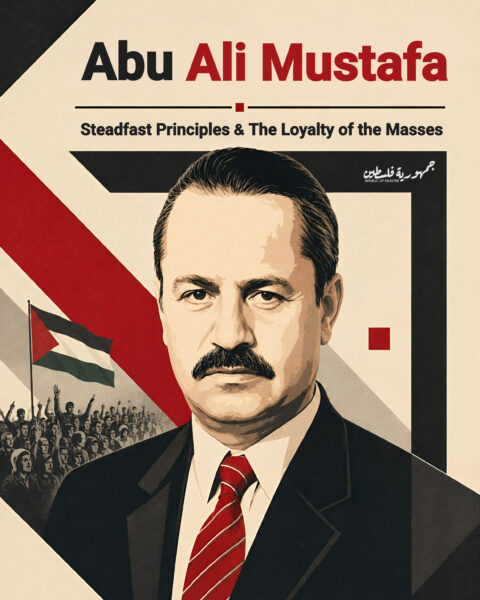

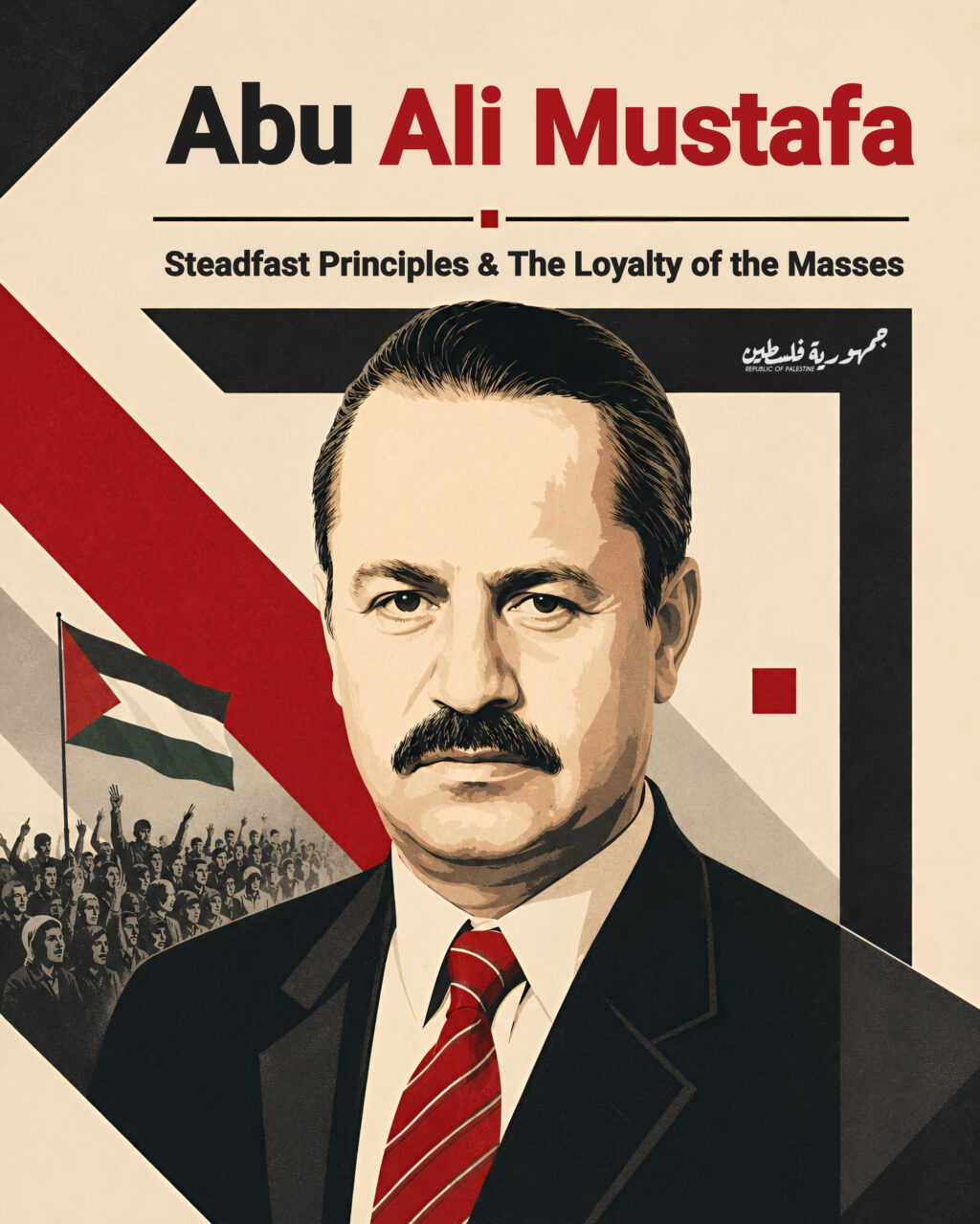

The anniversary of the assassination of national leader Mustafa al-Zibri (Abu Ali Mustafa) comes again, highlighting the legacy of a distinctive political leader who may have left the political arena, but whose struggle legacy remains difficult to erase. Abu Ali Mustafa was more than the Secretary-General of a political organization. He was a mentor and an architect of organizational and tactical work, and a pioneer in establishing a model of direct, field-based leadership rooted in the streets. He represented a steadfast political line that brought together revolutionary theory and organized action on the ground.
Mustafa Ali al-Ali al-Zibri was born in 1938 in the town of Arraba, in Jenin. He grew up in a working-class family. His father was a peasant who also worked on the railway and at the port of Haifa, and had taken part in the Great Palestinian Rebellion of 1936. In 1950, Abu Ali moved to Amman, where he continued his education. It was there that his political consciousness began to take shape in earnest, when he joined the Arab Nationalist Movement in 1955. In 1957, he was arrested in Jordan and spent several years in prison because of his political activities. Following his release, he attended military training for Fedayeen (Guerrilla) officers at the Anshas military school in Egypt in 1965. Following the defeat of June 1967, he joined his longtime comrade, Dr. George Habash, in establishing the Popular Front for the Liberation of Palestine (PFLP); this step was a defining milestone in his revolutionary career.
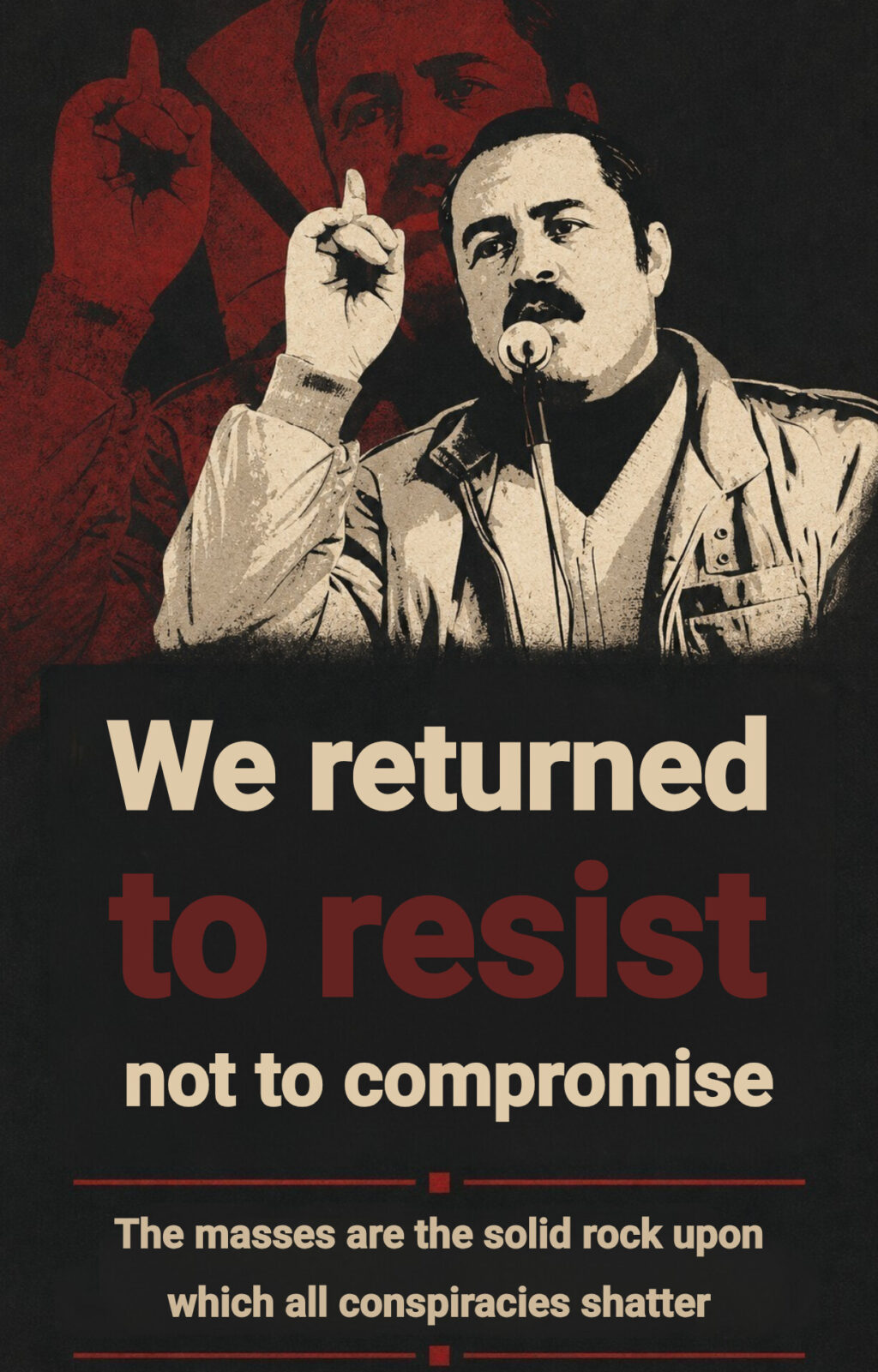
Abu Ali Mustafa’s return to Palestine in September 1999 marked a pivotal moment in modern Palestinian history, noting that the PFLP leadership had engaged in extensive debate before his return. It was not an endorsement of the Oslo Accords, which he had firmly opposed, but rather a repositioning of the resistance from within. Upon his arrival, he articulated his now-famous declaration: “We have returned to resist, not to compromise.” His presence among his people, he maintained, was intended to uphold Palestinian rights and pursue direct confrontation.
At the PFLP’s Sixth National Conference in 2000, he succeeded Dr. George Habash as Secretary-General, taking the helm at a particularly sensitive juncture. He set about reorganizing the Front’s military and political ranks and laying the foundations for its armed resistance action as the Second Intifada began.
Abu Ali Mustafa possessed a clear strategic vision for managing internal contradictions and regarded national unity as the safeguard of any Liberation Project. He worked to establish the foundations of broad-based partnership among all national and Islamist forces, without exclusion, through adherence to a shared minimum program. He firmly opposed any form of internal armed conflict or struggle for power, repeatedly emphasizing that the masses were the solid rock upon which all conspiracies would ultimately break.
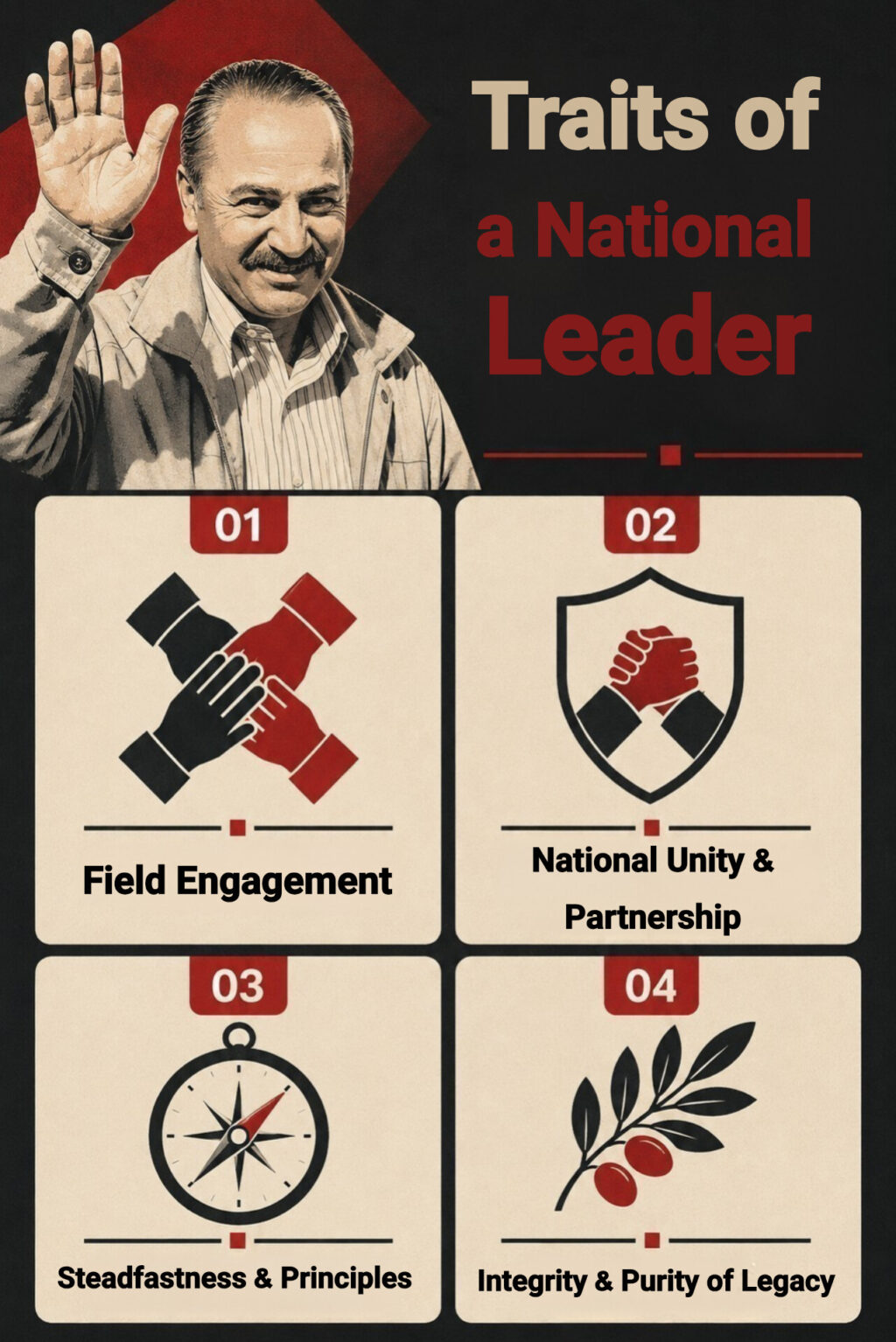
He also called for rebuilding the institutions of the Palestine Liberation Organization (PLO) on the basis of broad and representative inclusion, restoring its unifying role in the national struggle. This approach continues to inform calls today by the PFLP for an inclusive national dialogue bringing together the Secretaries-General of Palestinian factions in an effort to reorganize the internal Palestinian political house to confront plans for displacement and the dismantling of the Palestinian cause.
On Monday morning, August 27, 2001, occupation helicopters targeted his office in the city of al-Bireh, near Ramallah, with two missiles. He was martyred while surrounded by his papers and carrying out his responsibilities on the ground, becoming the first senior Palestinian political leader to be assassinated during the Second Intifada.
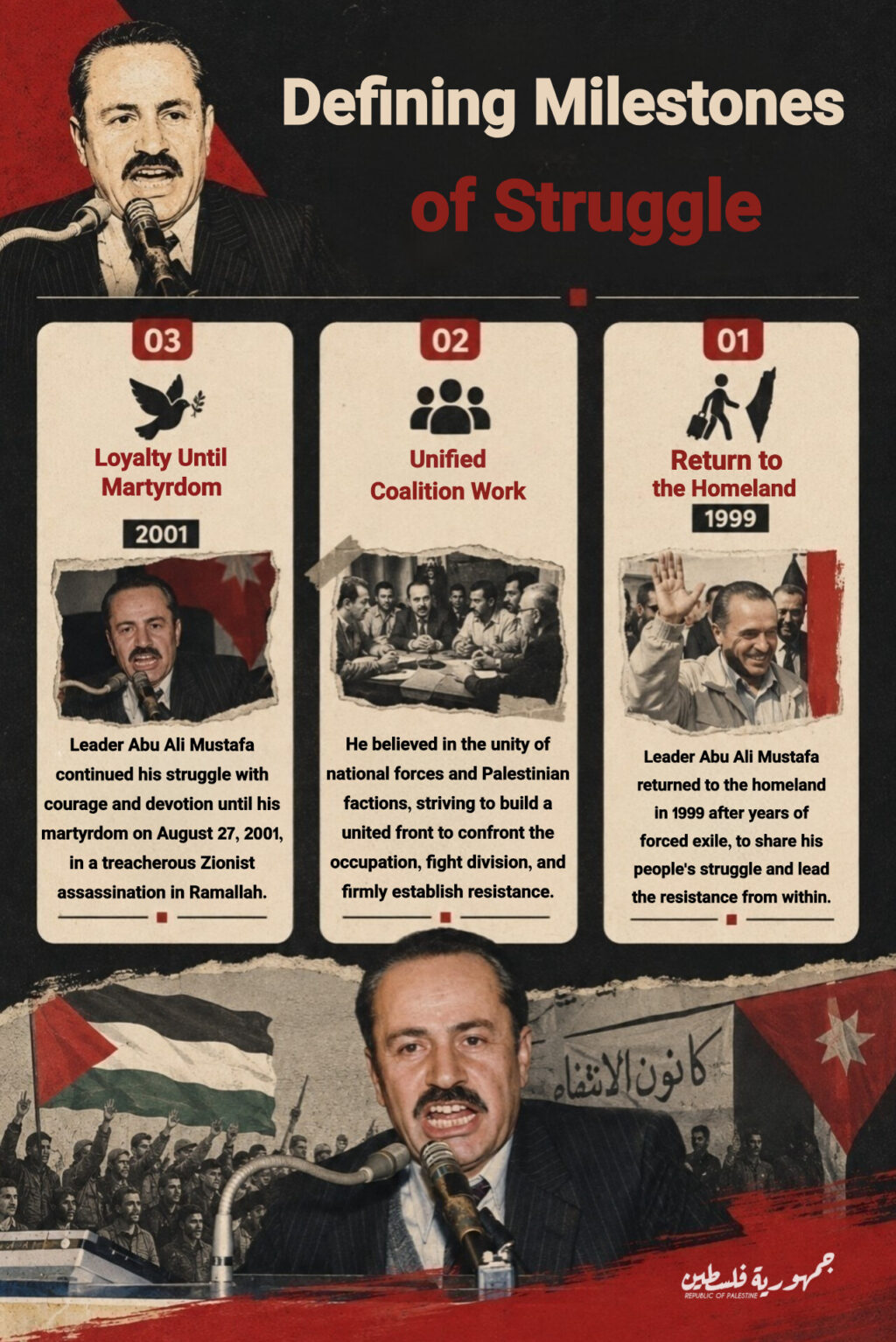
Through his assassination, the Zionist occupation sought to deliver a severe blow to the organization’s structure and to the political line that Abu Ali Mustafa represented, apparently calculating that targeting the Secretary-General would trigger a state of political and organizational collapse. He was succeeded by Ahmad Saadat as Secretary-General. The PFLP subsequently named its military wing the Abu Ali Mustafa Brigades in his memory.
On October 17, 2001, the brigades carried out a strategic retaliatory operation, assassinating Zionist Tourism Minister Rehavam Ze’evi in an operation known as “Holy Revenge,” a historic precedent that marked a significant moment in the Palestinian struggle, establishing a new balance of deterrence.
Abu Ali Mustafa may have departed this world in body, but he left the revolutionary movement a comprehensive political and organizational approach grounded in discipline, clarity in struggle, and direct engagement with the people. Throughout his long career, he proved that leadership is not defined by titles or positions, but by principled commitment and a complete readiness to make sacrifices for the dignity and freedom of the Palestinian people.
His legacy therefore remains a living compass in confronting challenges and defining historical moments.