
Special Coverage – Republic of Palestine
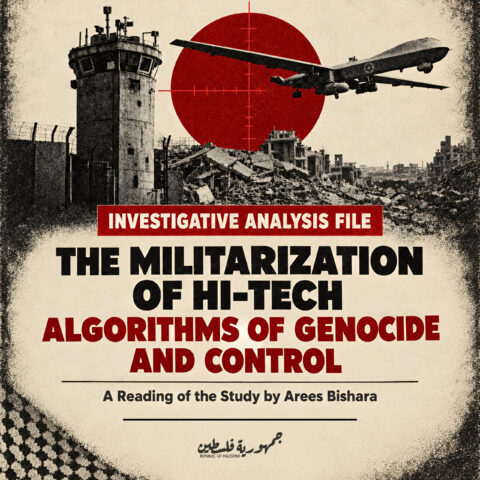
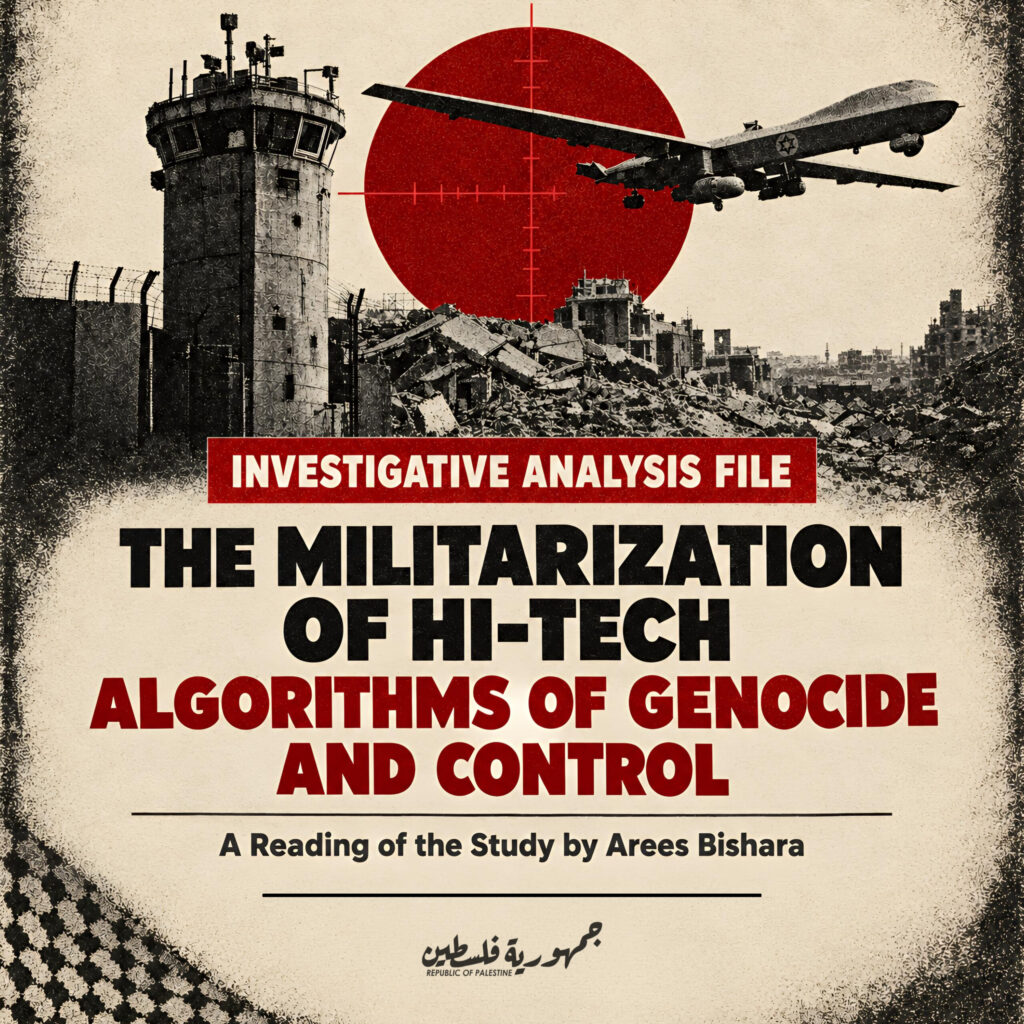
When the myth of the “Start-Up Nation” and the celebration of technological innovation begin to unravel, what remains is the face of a colonial regime that has transformed digital advancement into an instrument of domination and violence. This is the picture presented by an extensive academic and investigative study published by the Institute for Palestine Studies and authored by researcher Arees Bishara as a major chapter in Israel General Guide 2025.
Titled “The High-Tech Industries in Israel: Origins, Structure, and the Colonial Dimension,” the study goes beyond examining the sector’s economic success. It demonstrates how technological development has been integrated into a broader system of military control, surveillance, and violence, turning occupied Palestinian land into a testing ground for technologies later deployed in Gaza, the West Bank, Lebanon, and beyond.
The Myth of “Free Innovation”: When the Military, Academia, and Capital Converge
The study argues that Israel’s technological rise was not simply the product of a free market or individual entrepreneurship, as neoliberal narratives often suggest. Rather, it emerged through decades of direct state investment and military patronage dating back to the 1950s.
Bishara describes a tightly interconnected structure linking the military and intelligence establishment, particularly Unit 8200, with academic institutions such as the Technion and the Weizmann Institute, as well as private technology companies. Within this system, military training, technological research, and commercial development reinforce one another, blurring the distinction between civilian and military innovation.
Former military personnel often move into major defense and technology corporations, including companies such as Elbit Systems and Rafael, carrying with them expertise developed within the security apparatus and reproducing a model in which technological advancement remains deeply intertwined with military objectives.
Palestine as a Testing Ground: Digital Apartheid and Total Surveillance
According to the study, developments across the West Bank, Jerusalem, and Gaza reflect a strategy of what it describes as “remote-control occupation,” where surveillance technologies and automated systems help maintain control while reducing risks to Israeli military personnel.
The study documents the expansion of what it characterizes as a system of digital apartheid through facial-recognition programs such as Red Wolf, used at checkpoints in Hebron, and Blue Wolf, deployed across parts of the occupied West Bank. These biometric databases monitor, categorize, and track Palestinians on a mass scale.
It further highlights the use of spyware technologies, including Pegasus, against activists and civil society actors, as well as the role of Israel’s Cyber Unit in coordinating with major social media platforms to remove content and restrict Palestinian digital expression.
Gaza: The Automation of Killing
In its discussion of Israel’s ongoing war on Gaza, the study argues that technological systems have increasingly automated parts of the targeting process, transforming human lives into data points within algorithmic frameworks.
It examines systems such as Lavender, which reportedly processed data relating to millions of individuals in order to generate potential targets, as well as The Gospel, a system used to produce bombing targets and strike coordinates at unprecedented speed.
The study also discusses the tool known as Where’s Daddy?, which has been reported to track individuals in their homes, raising concerns about the targeting of people in civilian settings and the resulting civilian casualties.
Taken together, these systems represent what the study describes as a new phase in the industrialization and automation of warfare, integrated with drones, surveillance platforms, and advanced intelligence infrastructure.
Project Nimbus: The Complicity of Global Technology Giants
The study argues that these developments cannot be understood in isolation from major international technology corporations.
It points to the $1.2 billion Project Nimbus contract involving Google and Amazon, alongside cloud-computing services provided by Microsoft Azure, as examples of infrastructure that strengthens Israeli state and military data-processing capabilities.
Bishara notes that these partnerships have continued despite criticism from employees and activists involved in the “No Tech for Apartheid” campaign, which has challenged corporate involvement in technologies linked to surveillance, military operations, and human rights abuses.
The study also examines the broader role of technology platforms in shaping public narratives, moderating content, and facilitating political and military messaging during times of conflict.
Cracks in the High-Tech Economy
Despite the sector’s prominence, the study argues that Israeli high-tech is not immune to political and economic pressures.
As one of the principal pillars of Israel’s economy, accounting for a substantial share of GDP and exports, the sector has experienced growing uncertainty during the current war. The study points to disrupted investment flows, operational difficulties for companies in affected areas, and concerns among international investors about long-term stability.
According to the study, these challenges reveal structural vulnerabilities beneath the image of technological invincibility often projected by Israel’s political and economic leadership.
Conclusion
For Republic of Palestine, the significance of this study lies in its challenge to the common portrayal of technology as inherently neutral or detached from politics.
Instead, it presents technology as a central arena in which power, domination, surveillance, and resistance are contested. In doing so, it invites readers to look beyond the rhetoric of innovation and examine the political structures, military interests, and economic networks that shape technological development in the context of Palestine.
Readers may access and download the full chapter, published by the Institute for Palestine Studies, in both Arabic and English through the links provided below. officially issued by the Institute for Palestine Studies:
🔗 Click here to read and download the full study in Arabic (PDF)
🔗 Click here to read and download the full study in English (PDF)