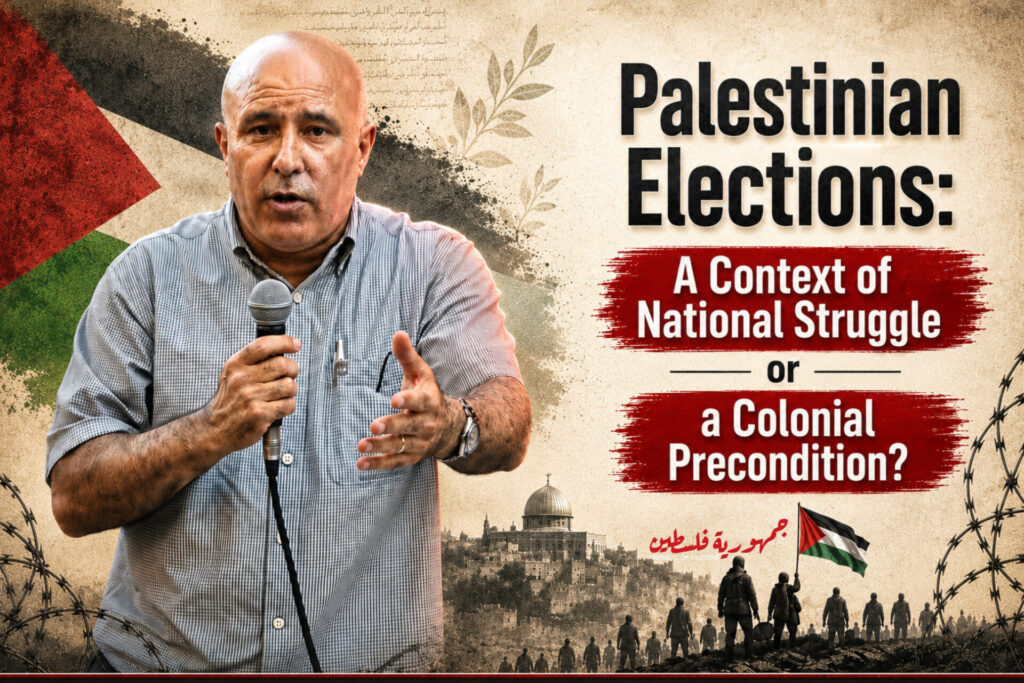

Dr. Fawzi Ismail
The call for elections to the Palestinian National Council comes at one of the most perilous moments in contemporary Palestinian history. The Palestinian people are confronting a genocidal war in Gaza, its extension into the West Bank through multiple forms of assault aimed at undermining the Palestinian presence, a systematic attack on the refugee cause, and an ongoing effort to fragment the identity, institutional unity, and political existence of the Palestinian people across the homeland and the diaspora. At such a moment, the question of national representation is fundamentally about defending Palestinian existence, not merely about exercising a democratic right.
Accordingly, the primary criterion for approaching this issue must arise from the principal contradiction with the Zionist project and the ongoing struggle against it and its supporters. These are the very actors shaping the current political trajectory according to colonial conditions that come at the expense of the Palestinian people’s inherent right to choose their leadership and determine their own future.
This is precisely why any electoral process conducted under the framework of the Oslo Accords and according to the logic of the “existing authority” is so dangerous. Instead of serving as a gateway to rebuilding a unified national front, elections risk becoming a mechanism for reorganizing the Palestinian political system in a manner that consolidates the status quo: an authority administering the West Bank, an isolated administration in Gaza, a marginalized diaspora stripped of political influence, and a Palestine Liberation Organization reduced to a symbolic cover for a political order that has lost its liberatory purpose.
National elections, in their true sense, must form part of the struggle against the Zionist project. Their value does not lie in procedural formalities but in the political program they serve. If elections are instead invoked merely to restore the legitimacy of the authority, reassure international donors, or reproduce a system of limited self-rule, then what is taking place is not the restoration of genuine national representation but rather its destruction and the erasure of what remains of its meaning. This ignores the Palestinian people’s urgent need for unified, militant political and institutional leadership capable of representing them and organizing their ranks in the struggle to defend their existence, rather than bargaining to preserve its own interests.
The current Palestinian crisis extends far beyond the absence of elections. It is a crisis born of the hijacking of national institutions and their transformation into instruments of a bureaucratic political class that has become disconnected from the people, from the refugee camps, from the diaspora, from the popular classes, from the prisoners’ movement, from the forces of resistance, and from the new generations living the daily reality of Zionist colonialism. Consequently, renewing the Palestinian National Council is a profound political task, inseparable from restoring popular sovereignty over national decision-making and repositioning that decision firmly within the national framework rather than in forces hostile to the national cause itself.
Procedurally speaking, it is evident that
the path proposed thus far has a distinctly top-down character. A decree is issued from above; a preparatory committee is appointed from above; predetermined quotas, seats, and criteria are established; and only afterward are political forces invited to join the process. This logic merely reproduces the existing crisis. The Palestinian national cause cannot be administered from a single center of power, reduced to a presidential decision, or constructed through closed-door understandings among security institutions and political elites.
A serious national process begins with genuine attentiveness and responsiveness to the popular will. It must move beyond these paternalistic formulas and open the way for an inclusive dialogue involving political, social, and grassroots forces both inside Palestine and throughout the diaspora. Such a dialogue should determine the entire framework of the process: the electoral law, mechanisms of representation, guarantees, political reference points, the powers of the National Council, and the relationship between the Council, the Palestine Liberation Organization, and the Palestinian Authority. Organizing the process in this way gives it a genuine national substance. Beginning instead with a presidential decree and then searching for political endorsement afterward reduces society and its political forces to mere spectators of a decision already made.
Elections to the Palestinian National Council require a clear political resolution before procedural questions are addressed. They must serve as the gateway to rebuilding the Palestine Liberation Organization on the foundations of national liberation, resistance, and popular representation—not as a means of renewing the legitimacy of the existing governing authority. What is needed is a National Council capable of holding the leadership accountable, defining the national political program, reaffirming the right of return, reconnecting Palestinians across the homeland and the diaspora, and opening political space to the living forces of society—not another institution that merely rubber-stamps the existing order.
Any electoral process that pre-selects which political forces are acceptable and which are not inevitably becomes an instrument of political control. Participation in the National Council should rest on belonging to the Palestinian people and commitment to their inalienable national rights: liberation, return, self-determination, equality, and the dismantling of the settler-colonial and genocidal system imposed upon them. Conditions based on recognition, ostracization, or condemnation, or limiting resistance according to definitions acceptable to the occupation or the international community, exclude the greater part of the Palestinian people and make the Council a distorted institution.
It must be stated clearly: the exclusion of Hamas, Islamic Jihad, or any other
national force produces a National Council lacking real representativeness. At the same time, the participation of these forces must occur within the framework of acomprehensive democratic reconstruction of the Palestinian national movement, not through elite power-sharing deals that treat the Palestinian people as a compliant audience summoned for sacrifice yet excluded whenever relevant political decisions are made.
The urgent priority is to mobilize national and popular struggle by broadening representation while politically isolating the approaches associated with the ruling elite and restoring a collective liberation-oriented national vision. This requires opening the political arena to popular organizations, democratic movements, trade unions, women’s organizations, youth movements, and refugee communities, rather than perpetuating the monopoly of decision-making among the same centers of power.
The Palestinian diaspora is the heart of the national question, not at its organizational margins. The Palestinian people were not politically constituted solely within the borders of the West Bank and Gaza, but also in refugee camps, places of exile, and communities extending from Lebanon, Syria, and Jordan to the Gulf, Europe, and the Americas. Consequently, diaspora representation must be one of the foundational pillars of any new National Council. Reducing it to a limited number of seats distributed through appointments, elite consensus, or political accommodation weakens the very essence of Palestinian representation. The same principle applies to the representation of Palestinians living in the 1948 occupied territories.
Diminishing the representation of the Palestinian diaspora and refugee camps—or treating it as merely symbolic—objectively aligns with broader efforts aimed at erasing the refugee question altogether A Palestine Liberation Organization that loses its connection with the refugees loses an essential part of its historical significance. For this reason, the struggle over the National Council is also a battle over memory, return, and the unity of the Palestinian people, not just a contest over parliamentary seats.
Jerusalem and Gaza constitute a decisive test for any genuine national process. They are not secondary electoral issues but embody the very questions of sovereignty and struggle. Gaza is not an electoral district whose participation can be postponed pending security arrangements; it is the epicenter of the current confrontation with the Zionist project. The war on Gaza—with its genocide, siege, destruction, and attempts at forced displacement—must stand at the center of any Palestinian political process. Elections that ignore Gaza’s suffering, sacrifices, and urgent need to stop the aggression, the break of the siege, and reconstruction freed from political blackmail, become detached from the lived reality of the Palestinian people.
Decrees issued by a presidency that has lost its own electoral legitimacy can not generate new national legitimacy. In the Palestinian context, legitimacy derives from the people, from the political program, from resistance, and from the ability to represent the Palestinian people as a whole—not from control over the administrative, financial, and political apparatus of the Palestinian Authority or from arrangements designed to satisfy international sponsors. Imposing a political process from above under colonial and international pressure only deepens the crisis of representation instead of resolving it.
A genuinely popular path begins with clear principles: First, an unwavering commitment to confronting the occupier; Second, the participation of all political and social forces without exclusion or conditions designed to favor one side over another; Third, a strict separation between the Palestinian Legislative Council elections and the Palestinian National Council elections, since conflating the Palestinian Authority with the Palestine Liberation Organization has been one of the most dangerous mechanisms through which the national liberation project has been absorbed into the structures of limited self-rule.
This must be accompanied by genuine representation for the diaspora and refugees, the full inclusion of Jerusalem and Gaza as integral components of the national process, the restoration of political, trade union, and media freedoms, and an end to political arrests and the persecution of activists and resistance figures. The process also needs an independent and nationally-agreed electoral commission together with an electoral system capable of ensuring meaningful representation for democratic and popular forces, limiting the influence of the wealth and coercive power of the security apparatus.
The National Council must possess actual authority to rebuild the Palestine Liberation Organization, hold its leadership accountable, and define its political program. Its mission should be to restore the Palestinian national project as a project of liberation; to connect political representation with popular, political, legal, and mass resistance; and to place confronting settlements’ expansion, annexation, genocide, and security coordination at the center of the Palestinian national agenda.
Such a position needs tools of action, not declarations of intent alone. The struggle begins with broad media and political efforts directed toward Palestinian and Arab public opinion, exposing the top-down character of any imposed political process and moving the discussion from closed rooms into the public sphere. Positions must emerge from refugee camps, diaspora communities, trade unions, professional associations, and grassroots organizations—not solely from political leaders. National representation becomes authentic only when it becomes the subject of popular struggle and not material for bargaining among competing elites.
Dr. Fawzi Ismail is a Palestinian activist and former president of the Union of Palestinian Communities and Organizations in Europe.