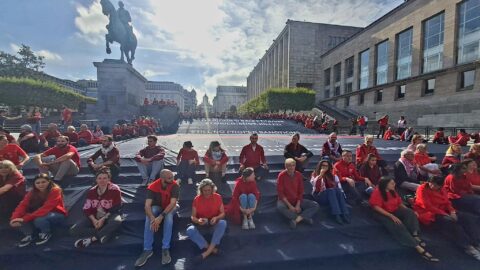
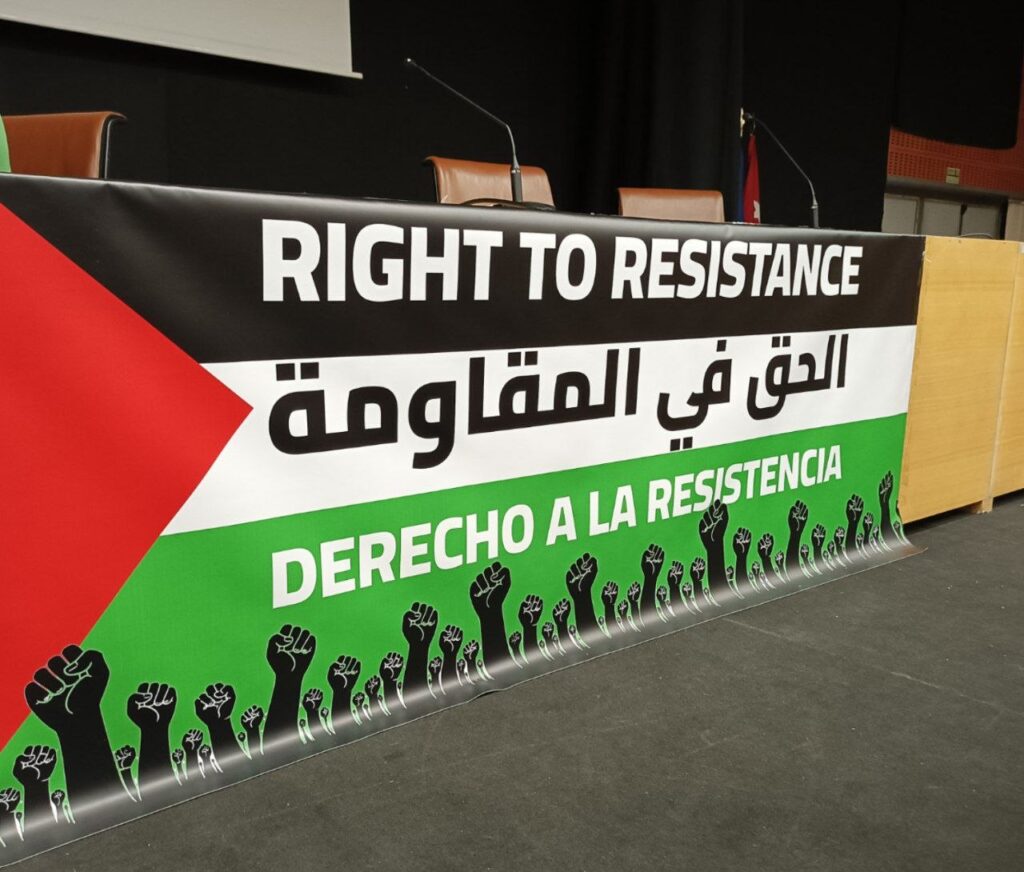

On 13-14 June 2026, representatives of human rights associations, political organisations, solidarity networks, legal practitioners, researchers, activists and individuals directly affected by proscription, sanctions, and counter-terrorism frameworks gathered in Madrid for the “Right to Resistance” conference.
The conference was convened at a moment when the global architecture of the War on Terror continues to expand beyond its original justifications, serving not merely as a security framework but as a system of political governance. Across Europe and beyond, counter-terrorism laws, proscription regimes, sanctions frameworks, surveillance powers, and financial restrictions have become instruments through which states regulate political legitimacy, suppress dissent, criminalise resistance, and facilitate colonial domination.
Participants concluded that so-called terrorist listings and the sanctions and restrictions that flow from them constitute a central pillar of this architecture. Far from being neutral legal mechanisms, they operate as political instruments that enable imperial intervention, entrench global hierarchies of power, and extend forms of coercion beyond the territorial reach of states.
These frameworks have facilitated war crimes, collective punishment, political persecution, and the erosion of fundamental political freedoms. They have been used to isolate liberation movements and societal and elected political forces, criminalize solidarity, and deny peoples the ability to determine their own political futures and choose their representatives. At the same time, they have empowered governments and authorities implicated in grave violations of international law and human rights.
Participants further recognised that these measures form part of a broader international system of repression and collective punishment sustained through cooperation between states, repressive regimes, intelligence agencies, financial institutions, and supranational bodies. Together, they have narrowed political space, severed relationships of solidarity between peoples, and imposed state-controlled narratives that obscure the realities of oppression, occupation, and resistance.
The conference discussions centred the Palestinian struggle as one of the clearest examples of the impact of this global architecture. For decades, Palestine has served as a testing ground for colonial brutality, genocidal wars, military occupation, and political criminalization.
The economic and financial sanctions imposed on Palestinians by EU governments and the US after Hamas’s victory in the 2006 elections in the West Bank and Gaza Strip were a key tool in Israel’s starvation policies against the Palestinians, particularly in the Gaza Strip. Their impact extended to legitimizing collective punishment through starvation of the Strip’s inhabitants, culminating in the large-scale starvation operations that formed part of the tools of genocidal warfare in 2024-2025.
Participants observed that the political and legal architecture created through proscription and counter-terrorism frameworks has provided essential cover for Israel’s assault on Gaza. By criminalising Palestinian political actors, delegitimising Palestinian institutions, and obscuring the chain of causation that underpins Palestinian resistance, these frameworks have contributed to international complicity in the destruction of civilian life, the targeting of journalists, the dismantling of healthcare and relief institutions, and the obstruction of humanitarian assistance.
The conference further noted that the expansion of these measures did not begin in October 2023. Rather, they form part of a longstanding pattern of European political support for the zionist colonial expansion and ethnic cleansing. Recent regulatory developments, including additional measures introduced by the European Union during the genocide in Gaza, demonstrate the continued willingness of European institutions to deepen this trajectory.
Participants affirmed that solidarity, collective struggle, political organisation, and international cooperation remain the most effective means through which peoples can confront systems of oppression and resist colonial domination. They expressed their unwavering solidarity with all those targeted by systems of political repression and reaffirmed their unequivocal support for the Palestinian people, their right to life, dignity, self-determination, resistance to occupation, ethnic cleansing, and genocide.
Participants further affirmed that challenging the consequences of proscription requires confronting the broader architecture of the War on Terror itself. The struggle against criminalisation, surveillance, sanctions, censorship, political imprisonment, and colonial violence cannot be separated. They form interconnected manifestations of a single political project that must be collectively challenged.
The Madrid Conference on the Right to Resistance therefore commits itself to the following areas of collective action:
1. Challenging Proscription and Terror Listings
Coordinate efforts to expose and challenge proscription regimes and terrorist listings as instruments of political repression, colonial domination, and the criminalisation of resistance.
2. Defending the Right to Resistance
Advance political, legal, and public advocacy affirming the legitimacy of resistance to occupation, colonialism, ethnic cleansing, and genocide.
3. Opposing the Criminalisation of Palestine Solidarity
Resist all attempts to suppress, surveil, restrict, or criminalise solidarity with Palestine and support those targeted for their advocacy and organising.
4. Confronting Surveillance and Security Powers
Expose and challenge the expansion of surveillance regimes, intelligence cooperation, policing powers, and security frameworks developed under the War on Terror.
5. Resisting Financial Warfare and Sanctions
Challenge the use of sanctions, banking restrictions, compliance regimes, and financial exclusion as tools of collective punishment and political coercion.
6. Defending Political Organisation and Civil Society
Protect organisations, institutions, charities, trade unions, community groups, journalists, researchers, and political actors targeted through counter-terrorism frameworks.
7. Challenging Narrative Control
Develop coordinated interventions to confront the narratives of terrorism, extremism, and security that are used to justify repression and delegitimise resistance.
8. Exposing Institutional Complicity
Hold governments, corporations, financial institutions, universities, media organisations, and international bodies accountable for enabling war crimes, repression, occupation, and genocide.
9. Building Collective Defence and International Solidarity
Strengthen cooperation between movements, communities, lawyers, researchers, parliamentarians, and campaigners confronting repression across different contexts and geographies.
10. Building a Movement Against the War on Terror
Work towards the development of a sustained European and international movement capable of dismantling the legal, political, financial, and ideological architecture of the War on Terror and its enduring consequences.
The participants regard this declaration not as the conclusion of a conference but as the beginning of a process. We commit ourselves to building the structures, relationships, and campaigns necessary to transform analysis into action, solidarity into collective power, and resistance into a coordinated challenge to repression, colonialism, and complicity.
Madrid, 14 June 2026 Conference on the Right to Resistance