
by Bissan Edwan
The genocide in Gaza has not ceased; it has taken on other forms and practices. Despite this, the occupation continues to bombard neighbourhoods and areas. Amidst the ongoing genocide in the Gaza Strip, a new form of colonial control is emerging control over the Palestinian body after death. It is not enough for a Palestinian to be killed in Gaza or arrested and tortured in the West Bank and Jerusalem or besieged in small neighbourhoods as if their life has become confined to dark and desolate spaces, or even forcibly disappeared without a trace.
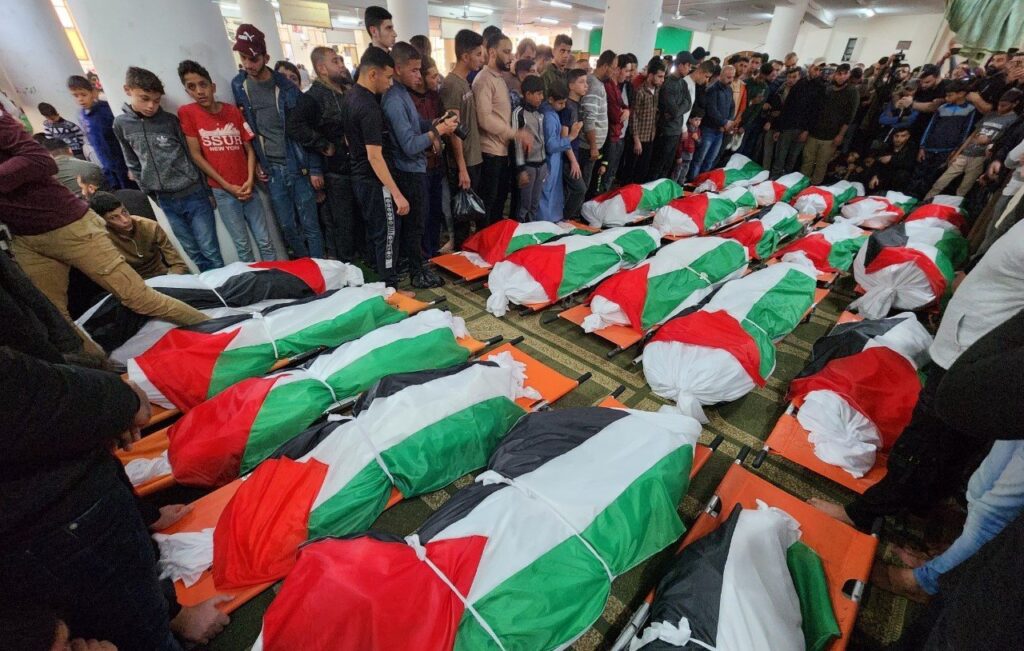
This painful and documented reality is not merely stories or figments of the imagination, but rather firsthand accounts from occupation doctors and Palestinian testimonies submitted to human rights organizations. These testimonies confirm the horror of these practices, which bear the harsh mark of oppression and humiliation, accumulated over years and still part of the daily life of Palestinians. In October-November 2025, specifically after the ceasefire agreement of October 10, 2025, the process of returning Palestinian bodies held by Israel to Gaza began. However, what was returned was not a dignified burial, but rather mutilated bodies, missing limbs, with their hands and feet bound, making identification difficult for their families. On October 16, 2025, the Ministry of Health in Gaza received 30 Palestinian bodies returned from Israel. The report stated that some of them “bore signs of torture, restraint, and blindfolding.” (WAFA Agency) Then, on October 19, another batch of 15 bodies was returned, bringing the total to approximately 150 bodies at that stage. (Ahram Online) With the arrival of November, on November 3, 2025, Gaza received an additional 45 bodies, bringing the total number of bodies received by the Ministry of Health since the start of the ceasefire to 270. (WAFA Agency) On November 8, another batch of 15 bodies was returned, bringing the total number of bodies recovered since October 10 to approximately 300, according to the Ministry. (PressTV)
These figures are not merely numbers; they are evidence of the transformation of the Palestinian body into a bargaining chip, a post-mortem colonial experience.
Bio colonialism: From Controlling the Land to Controlling Flesh and Bone
These practices are not an exception or a phenomenon alien to history. Throughout the ages, colonialism has not been content with occupying land and controlling the economy and politics but has extended to include the bodies of the indigenous population, living and dead, under vague pretexts related to medicine, civilization, or humanity. This control over the body has been, and remains, part of colonial strategies for imposing hegemony and suppressing the other, transforming them from human beings with dignity and pain into mere commodities to be used and consumed.
Whenever the occupation fails to break the Palestinian as a living human being, it goes further to exact revenge on their body after death. The Palestinian body is not merely human remains to be died and buried, but rather vital material in a complex colonial game employed by the post-colonial system. In this system, the oppressor not only kills but also exercises a form of “necro power” over the victim, transforming their body into a new arena for oppression and subjugation.
Since the late 1990s, testimonies have emerged about the institute’s use of Palestinian corpses as a source of organs and tissues without the knowledge or consent of their families. The most notorious case came to light in 1997 when the body of a military officer’s son was found mutilated. He stated, “I saw that they had tampered with the body and practiced on it. There were no corneas in his eyes… Even my wife, who isn’t a doctor, knew that he didn’t have corneas.”
In a 2000 investigation, the Israeli newspaper Yediot Aharonot revealed that the institute was stealing organs from corpses and selling them for research without the families’ knowledge. The investigation quoted institute employees as saying that internal organs were stolen from bodies during autopsies. In 2009, Dr. Yehuda Hiss, who headed the institute for decades, admitted that his institution had harvested organs from the bodies of Palestinians and Israelis without official authorization.
The interpretation of scholars like Edward Said on this matter transforms the Palestinian body into an object of knowledge under the scalpel of power, where the victim is treated not as a human being but as an anatomical object reproduced within a colonial epistemological hierarchy.
Investigations by Swedish journalist Donald Boström (2009, 2014) documented testimonies from Palestinian families who received the bodies of their loved ones after they had been held for extended periods. The bodies bore stitching marks from the neck to the abdomen, without any clear medical explanation. The investigations revealed that Israeli forces or affiliated entities were systematically and methodically removing vital organs from the bodies of Palestinians killed during confrontations, without the consent of the martyrs’ families. These practices illustrate how the body is transformed into an anatomical stockpile subjected to processes of depletion: skin grafted, corneas harvested, corpses decomposed and remains retrieved for recycling within a perpetually renewed colonial system.
Mass Graves as a Tool for Memory Control
On August 5, 2024, the Israeli occupation returned the bodies of 89 Palestinians in a shipping container to Khan Younis, in a scene that encapsulates cruelty: bodies so badly decomposed they were almost unrecognizable, arriving in the homes of the living as a message of mass death instead of allowing families to identify their loved ones.
Later, Palestinian media reported that families of martyrs in late 2023, while searching some mass graves in central and southern Gaza, found bodies missing vital organs. Some Palestinian doctors suggested that the removed organs may have been used for research or the black market.
According to the Euro-Mediterranean Human Rights Monitor, Israel has a long history of withholding the bodies of Palestinians: it holds at least 145 bodies in special morgues, in addition to approximately 255 in “cemeteries of numbers” and 75 missing persons whose bodies it refuses to acknowledge being held.
These cemeteries are not burial sites, but rather silent laboratories for erasing memory and dehumanizing the victim. They are part of a system that views the Palestinian body as an anatomical repository, not to be honored in death, but rather dissected, stored, and stripped of its name and skin—a practice that merges medicine with symbolic domination and reproduces colonialism in its contemporary, dynamic form.
International Laws and Conventions: A PathLegal Beyond the Body
International Humanitarian Law (IHL) explicitly stipulates obligations regarding corpses and graves—it is not enough to focus solely on the living.
• The four Geneva Conventions (1949) and their Additional Protocols stipulate that parties to a conflict “shall take all feasible measures to prevent bodies from being plundered or seized”; bodies must also be treated “with respect and dignity.”
• According to Article 17 of the First Convention, burial or cremation must be preceded by a medical examination to confirm death, and the burial or cremation must be carried out as closely as possible to the victim’s rites and in a manner that allows for subsequent identification.
• Rule 113 of the Manual of Customary International Humanitarian Law states: “Each party shall take all feasible measures to prevent bodies from being plundered. Mutilation of cremated or otherwise disfigured bodies is prohibited.” • Furthermore, degrading treatment or mutilation of corpses is considered a crime under some national laws. A Swedish court ruled that placing a part of the body on a corpse and taking photographs next to it constitutes a war crime.
• The International Committee of the Red Cross and the Office of the High Commissioner for Human Rights have also emphasized that burials without identification or the handover of unnamed or unregistered bodies constitute a violation of the dignity of the deceased and their families.
Therefore, the Palestinian situation we are referring to—the withholding of bodies, their handover in a mutilated state, their burial without names, and delays in identification—represents a flagrant violation of a range of binding international rules in conflict.
Why is what is happening not merely a tactical error?
The Israeli occupation has never been simply a settler-colonial project, but rather a biopolitical colonial system that controls time, the body, and death. This pattern of control, which the Cameroonian thinker Achille Mbembe describes as “necro politics,” empowers the authorities to determine who lives and who is left to die, who is buried and whose body is held indefinitely.
In this context, the Palestinian body is no longer a human being but a living substance, dissected, exploited, and held captive. These are not accidental or aberrant practices, but rather part of a vital colonial logic: the Palestinian body is not merely killed in confrontation but is reclaimed as material for the reproduction of dependency, subjected to dissection, its history, pain, and dignity relegated to the background.
When bodies are handed over mutilated, detained without identification, or buried in nameless graves, the victim does not simply receive burial; their existence is erased, their traces obliterated, and the conflict shifts beyond life. It is a form of control over death, no less cruel than control over life. What we write today is not a call to deny reality, but rather an opening for the pursuit of justice: to restore the dignity that has been stolen, to reclaim the names that have been erased, to ensure a dignified burial instead of a desecrated one.
It is not enough to count the dead; we must restore their names, their faces, and their dignity. Defending the dead is the last resort to liberate the living from the shackles of political calculations and to restore to the Palestinian body its rightful place as a human being, not merely as a physical object.
References and sources
- WAFA English Agency, Israel returns bodies of Palestinians killed in Gaza, October–November 2025.
https://english.wafa.ps/Pages/Details/164025 - Ahram Online (English Edition), Israel returns Palestinian bodies to Gaza – Health Ministry, 19 October 2025.
https://english.ahram.org.eg/NewsContent/58/1262/555199 - Press TV UK, Israel hands over dozens of Palestinian bodies to Gaza amid ceasefire deal, 8 November 2025.
https://www.presstv.co.uk/Detail/2025/11/09/758471 - Euro-Med Human Rights Monitor, Israel’s retention of Palestinian corpses a form of collective punishment, 2024–2025 reports.
https://euromedmonitor.org - Amnesty International, Israel/OPT: Unlawful retention of Palestinian bodies must end, 2023–2024 statements.
https://www.amnesty.org - Human Rights Watch, Israel’s treatment of Palestinian detainees and remains, 2023–2025 documentation.
- https://www.hrw.org
- Donald Boström, Our sons plundered for their organs, Aftonbladet Investigation, 2009; follow-up 2014.
https://www.aftonbladet.se - International Committee of the Red Cross, Customary IHL Database – Rule 113: Treatment of the Dead.
https://ihl-databases.icrc.org/customary-ihl/eng/docs/v1_rul_rule113 - Rome Statute of the International Criminal Court (1998), Article 8 (2)(b)(xxi).
https://www.icc-cpi.int/sites/default/files/RS-Eng.pdf