
Exclusive for “Republic of Palestine” | Investigative Journalism & Research Department
The relentless genocidal war in the Gaza Strip, now raging for more than two years, has been reframed by hard data and international investigative consensus. It is no longer viewed merely as a localized military assault by an isolated occupation, but as a global colonial enterprise whose lethal arsenal is sustained by transcontinental economic partnerships and financial infrastructures. Behind the screens broadcasting live slaughter—which has claimed the lives of tens of thousands of Palestinian civilians—lies a complex international support network. Its financial and logistical anatomy has been dissected by tracking global shipping movements and cross-referencing them with data from the world’s leading peace research institutes. The findings expose a structural complicity that goes far beyond traditional diplomatic backing, entering the realm of organic, shared involvement in the machinery of mass murder and ethnic cleansing.
Re-engineering the Armaments Map: The Reality of Geopolitical Balances
Updated official data from the Stockholm International Peace Research Institute (SIPRI) and the Global Arms Transfer Database reveal a precise and rigid architecture underpining the direct military supply to the Israeli army. The United States dominates the lion’s share of major weapons systems and destructive platforms, accounting for 68% to 70% of total imports. It is followed by the Federal Republic of Germany in a historic and active second place, maintaining a share of approximately 30% to 31%. Statistical indicators documented in SIPRI’s technical briefs confirm that Washington and Berlin together monopolize more than 98% of the major military arsenal supplied to the occupation. This confronts the international community with an undeniable fact: the weapons of mass destruction deployed in the field are a Western industry par excellence, managed with a green light and direct funding from the capitals of historic colonial systems.[1]
Flipping the Geopolitical Equation: From Supplying to Importing
In contrast to direct Western supply, investigative reports cross-referenced by Amnesty International and Declassified UK drop a bombshell of a different kind: the strategic rise of the Republic of India within the Israeli military landscape. However, this is achieved by completely flipping the statistical data. India is not classified in international databases as an arms supplier to the occupation; rather, it officially stands as the “largest importer and consumer of Israeli weapons in the world” without rival, swallowing a massive share of 37% to 40% of total Israeli military exports. This geopolitical positioning reflects a stark strategic reality: over the two years of this war, the giant Indian customer has transformed into the hidden spine and the most critical lifeline protecting the Israeli military economy from total collapse under the weight of financial hemorrhage and mounting international isolation.[2] [3]
A Financial Lifeline: Injecting Liquidity into Military Capital
The military exchange between New Delhi and Tel Aviv transcends dry commercial ledgers; it is deeply embedded in the very structure of war financing. The Israeli defense economy and its corporate giants—such as Elbit Systems, Rafael, and Israel Aerospace Industries (IAI)—rely structurally on foreign export revenues to fund their exorbitantly expensive military research and development, and to cover the cumulative deficits driven by the prolonged war. At a time when the broader Israeli economy is reeling from the mobilization of hundreds of thousands of reservists and a sharp decline in foreign direct investment, the influx of billions of dollars from Indian taxpayers to purchase air defense systems, Spike missiles, and surveillance drones acts as an emergency bailout. This liquidity injection guarantees that these factories can keep production lines running, pay their engineers, and continue manufacturing the munitions that ultimately end up in the chests of innocent people in the Gaza Strip.
Gaza as a Marketing Lab: The Profitability of Palestinian Blood
The most ruthless commercial doctrine of military capitalism manifests in this alliance through the marketing formula governing Israeli sales to India. This trade relies fundamentally on branding exported weapons and systems as “Combat-Proven.” Rights organizations and structural analyses reveal that the Israeli occupation transforms the Gaza Strip—its residential blocks in both the north and south, and its displacement camps—into an open-air, cost-free testing ground to evaluate the efficiency of smart suppression technologies, targeted assassination drones, and digital espionage and phone-hacking software. Once these tools demonstrate their hyper-destructive and surveillance capabilities on Palestinian bodies and lives, they are exported to Indian markets at astronomical prices. Consequently, India is not merely purchasing abstract military hardware; it is investing directly in the “outcomes of genocide,” providing the financial incentive for the occupation to continuously develop and upgrade killing tools through a permanent consumer market.
Rear Production Lines: The Hyderabad Drones Scandal
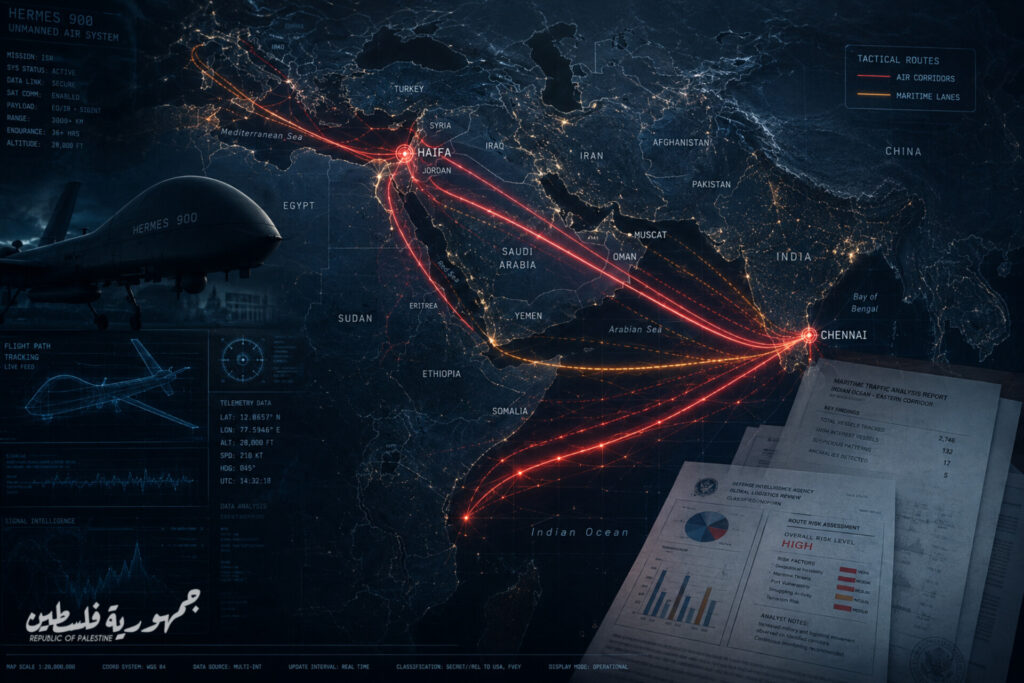
Although India is absent from the lists of major system suppliers, field-based investigative journalism published by independent Indian outlets like The Wire, in cooperation with British research groups, has documented organic logistical complicity by Indian companies in directly sustaining the Israeli war effort. This is vividly illustrated by the joint military factories operating in the city of Hyderabad between the giant Adani Group—owned by a billionaire closely tied to India’s ruling circles—and Israel’s Elbit Systems. During the war, these factories have turned into a rear production line and a safe haven for assembling and manufacturing key components and entire airframes for advanced Hermes 900 drones. These parts and components have been shipped directly from India to the Israeli Air Force, entering immediate service to bomb displacement shelters, execute targeted assassinations, and provide aerial intelligence for ongoing ethnic cleansing operations in the Strip.[4]
The Siege of Cartagena: Smuggled 155mm Shells
Logistical supply lines are no longer devoid of evidence; they have escalated into an international diplomatic crisis. In May 2024, the Spanish government intervened after tracking maritime routes carrying live ammunition and explosives. According to official data broadcast by Reuters and the Spanish newspaper El País, the Ministry of Foreign Affairs in Madrid strictly banned the Danish cargo ship Marianne Danica from docking at the southern port of Cartagena. The decisive ban was enacted after audit protocols revealed the ship had departed from the Indian port of Chennai bound for Haifa, carrying a critical cargo of 27 tons of explosive materials. This incident coincided with Indian customs export logs revealing that Munitions India Limited (MIL), a state-owned enterprise under the Indian Ministry of Defense, had pushed through covert deals to export complete 155mm artillery shells to the occupation. These very shells form the daily backbone of the occupation’s artillery barrages flattening residential neighborhoods in Gaza, elevating the partnership from economic support to direct patronage of battlefield slaughter.[5] [6] [7]
Substituting Labor: Piercing the Economic Siege
The dimensions of the New Delhi-Tel Aviv alliance extend beyond steel and weapons to the restructuring of the occupation’s socio-economic fabric under the darkest conditions of the war. At a time when the occupation imposed a suffocating siege on the West Bank and Gaza by canceling the work permits of more than 80,000 Palestinian workers as collective punishment, the Indian government rushed to operate an organized human airlift to fill this structural vacuum. Tens of thousands of Indian workers were deployed directly into vital construction, building, and infrastructure sectors across occupied cities, at the explicit request and under the supervision of the Israeli Ministry of Defense and private corporations. This massive demographic influx functioned as a “lifesaving serum,” preventing the Israeli real estate and construction sectors from total collapse and allowing the occupation to sustain its internal economy without bowing to humanitarian or economic pressures linked to the blockade.[8]
Radical Ideological Realignment: Betraying the Historic Legacy of Liberation
The intensification of these military and economic relations between New Delhi and Tel Aviv, unfolding amidst the continuous live broadcasting of massacres in Gaza, represents a complete rupture by India from its classical political doctrine and rich anti-colonial legacy. India, which historically formed the bedrock and leadership of the Non-Aligned Movement under the legacy of Mahatma Gandhi and Jawaharlal Nehru—and which long viewed championing the Palestinian people’s right to self-determination as a moral imperative—has seen its current doctrine hijacked by a neoliberal, right-wing extremist alliance that converges with settler-colonial Zionism. The ruling elites in New Delhi now view the Israeli model of population control, surveillance, home demolitions, and territorial dominance through armed force as an inspiring blueprint and a transferable strategic technology for their local conflicts. This cements the concept of “globalized oppression,” where authoritarian systems integrate to crush liberation movements.
International Responsibility: Breaking the Lifeline
This investigative report places progressive forces, labor unions, left-wing coalitions, and the international boycott movement before a historic responsibility to re-examine global networks of imperialist support. The blood of innocents in Gaza is not only spilled via American financing and direct German supply; it is spilled because a giant market in Asia pumps vital liquidity into the veins of the Israeli military economy, shielding it from isolation and bankruptcy. Exposing the New Delhi-Tel Aviv axis and focusing on boycotting joint ventures is now the primary moral weapon to besiege global military capitalism. Crucial leverage lies with international dockworkers’ unions—specifically the Water Transport Workers Federation of India, which issued an official directive refusing to load or unload any weapon shipments bound for the occupation [9]. This remains the path to severing the arteries of finance and slaughter that feed on Palestinian lives.
Certified References and Endnotes:
1. Stockholm International Peace Research Institute (SIPRI), Arms Transfers Database.
2. Amnesty International, Reports on Monitoring Weapon Pathways in Conflicts.
3. Declassified UK, Investigative Journalism Archive on Military Supply Chains.
4. The Wire (India), Investigative series on the Hyderabad military-industrial complex.
5. Reuters, Global News Documentation.
6. El País (Spain), Official archives on maritime blockades, May 2024.
7. Munitions India Limited (MIL), Official Customs Export Records.
8. Ministry of Labour and Employment (India), Bilateral Agreements and Labour Exchange Registries.
9. Water Transport Workers Federation of India, Official Union Resolutions and Declarations.